Fort Wayne Bathroom Pros · Southwest Fort Wayne, 46804
Bathroom Remodel & Renovation in Fort Wayne, IN Full Renovations, Walk-In Showers & Leak Repair
We remodel bathrooms across Fort Wayne and Allen County: full gut remodels, tub-to-shower conversions, walk-in and zero-threshold showers, new tubs, vanities, tile floors and countertops, plus repair and rebuild after leaks and burst pipes. Before any work starts, you get a detailed project plan that spells out exactly what we’ll do.
Water coming through a ceiling? Emergency guidance is available at (260) 272-8252.
Local bathroom remodelers
Which Fort Wayne bathroom remodelers check behind the walls first?
Fort Wayne Bathroom Pros is a local bathroom remodeling company based at 9426 Camberwell Dr in southwest Fort Wayne. We handle the whole job: design and layout, demolition, plumbing, electrical, ventilation, waterproofing, tile, fixtures and the final walkthrough. One phone number, one written work plan, one crew answerable for the result.
Most of the bathrooms we get called to aren’t just ugly. They’re tired in ways you can’t see. Fort Wayne’s median home was built in 1971, and more than 16,000 homes in the city were built in 1939 or earlier. Behind the tile in those houses we find cast iron drains, galvanized supply lines that choke water pressure, soft subfloors around the toilet and exhaust fans that dump wet air into the attic, if there’s a fan at all.
So we don’t plan a bathroom from a photo. We come out, look at what’s there, check for moisture and tell you plainly what the room needs. If a refresh is all you need, we’ll say so.
Quick answer: what does a bathroom remodel include?
A full bathroom remodel in Fort Wayne usually means taking the room down to the studs, fixing what’s behind the walls (pipes, subfloor, wiring, venting), then installing a new shower or tub, waterproofing, tile, vanity, toilet, lighting and fan. A bathroom renovation or refresh keeps the layout and the tub and swaps the surfaces and fixtures.
At a glance
- Business
- Fort Wayne Bathroom Pros
- Address
- 9426 Camberwell Dr, Fort Wayne, IN 46804
- Phone
- (260) 272-8252
- What we do
- Bathroom remodeling and renovation, tub-to-shower conversions, walk-in and curbless showers, tub replacement, vanities, flooring, countertops, accessible bathrooms, water-damaged bathroom repair
- How we work
- In-home consultation, then a detailed project plan before any work starts
- Permits
- Pulled through the Allen County Building Department for Fort Wayne and unincorporated Allen County
Real concerns
What worries Fort Wayne homeowners most before a bathroom remodel?
It’s rarely the tile color. It’s not knowing what’s included, being without a shower for weeks, and a contractor who finds rot halfway through or walks off the job. Here’s how we handle each one.
“I don’t know what’s actually included”
Every job comes with a written work plan covering demolition, plumbing, electrical, waterproofing, tile, fixtures, permit and cleanup. Nothing changes once the old tub is out unless you sign off on it.
“It’s our only bathroom”
We give you a realistic schedule before demo day, order the vanity, glass and tile ahead so nothing sits waiting, and tell you which days the water will be off.
“What if they find rot?”
In older Fort Wayne houses, they often do. We check the floor and walls with a moisture meter on the first visit and put in writing how hidden repairs are handled, so a surprise isn’t a shock.
“The last contractor walked off the job”
Local homeowner groups are full of half-demolished bathrooms left behind. We take on unfinished jobs, and we never ask for half up front.
“There’s a stain on the ceiling”
A brown ring below a bathroom usually means a failed shower pan, cracked grout or a leaking drain. We find the source first, then tell you if it’s a repair or a remodel.
“Mom can’t step over the tub anymore”
A low-threshold or curbless shower with a bench, a handheld sprayer and grab bars set into solid blocking. Built to look like a nice bathroom, not a hospital room.
What we do
Which bathroom remodeling services do we offer in Fort Wayne?
Everything from a single fixture to a full gut, for hall baths, primary (master) baths, half baths and basement bathrooms. These are the jobs Fort Wayne homeowners call us for most.
Quick answer: what’s the most popular bathroom upgrade right now?
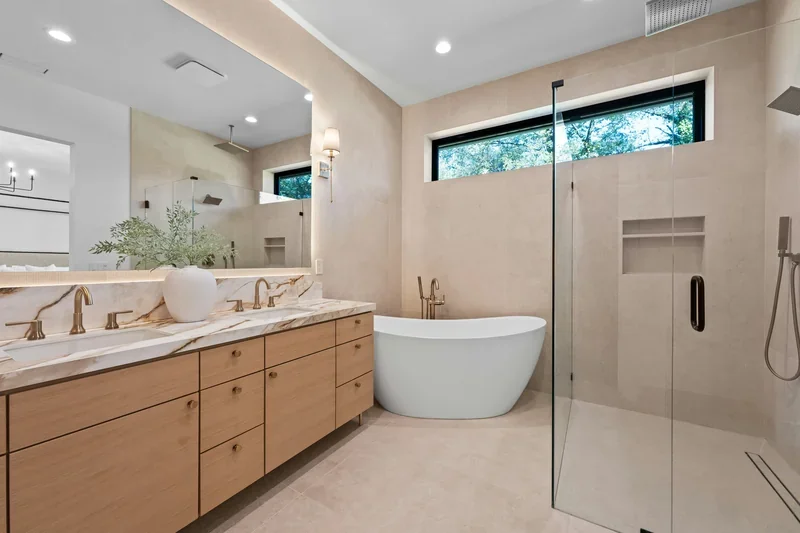
For homeowners planning to stay put, it’s pulling a tub nobody uses and building a walk-in shower with a low curb or none at all, a bench, a niche and glass. It’s easier to clean, easier to step into and safer as you get older.

Full Bathroom Remodels
Down to the studs. We replace old cast iron and galvanized pipe while the walls are open, repair joists and subfloor, add a ducted fan and GFCI circuits, waterproof the shower properly and finish it out.
Tub-to-Shower Conversions & Walk-In Showers
Pull the tub nobody uses, put in a walk-in shower with a low curb or none at all, a bench, a niche and glass. The most common upgrade we do for homeowners planning to stay put.
Water-Damaged Bathroom Repair
Leaking pans, burst pipes from a cold snap, a toilet that’s been seeping for years. We find the source, open what’s wet, dry it out, replace rotted wood and rebuild.
Zero-Threshold Showers
Curbless, walk-right-in showers with a linear or center drain and a floor sloped to it. Easier for older adults and people with disabilities, and they look clean.
Bathtubs
Tub replacement, deep soaking and freestanding tubs, clawfoot removal, and shower-to-tub conversions when a family needs a tub back. Refinishing only when the tub is sound.
Shower Remodeling
Shower replacement, new pans, frameless glass doors and partitions, benches, niches, slip-resistant floor tile and pressure-balanced or thermostatic valves.
Vanities & Storage
Stock, semi-custom and custom vanities, double vanities, wall-hung units for tight 5×8 baths, and refinishing a solid wood vanity when it’s worth keeping.
Bathroom Flooring
Porcelain and ceramic tile, natural stone and waterproof vinyl plank, over a sound, flat subfloor. Electric heated floors for January mornings.
Countertops
Granite, marble, engineered quartz (Cambria, Caesarstone, Silestone, Vicostone), quartzite, solid surface and cultured marble, plus quartz remnants for smaller vanities.
Fans, Lighting & Electrical
Quiet, humidity-sensing exhaust fans ducted outdoors, GFCI outlets, a dedicated circuit, vanity lighting and lighted mirrors.
Small, Half & Basement Baths
Space planning for 5×7 and 5×8 hall baths, powder rooms, and new basement bathrooms with ejector pumps and backwater valves where needed.
Accessible Bathrooms
Curbless entries, benches, handheld showers, comfort-height toilets and grab bars anchored into blocking, planned around the person who’ll use the room.
Fort Wayne housing
Why do older Fort Wayne bathrooms need more than new tile?
Because what’s behind the wall decides the scope of the job and how long the bathroom lasts. Fort Wayne has a deep stock of pre-war and midcentury homes, and each era hides its own problems.
Quick answer: how old is the typical Fort Wayne bathroom?
The city’s median home was built in 1971, so many bathrooms are on their second or third set of finishes over original pipes, subfloor and venting. Homes built before 1978 also get lead-safe work practices during demolition.
Remodeling a house from the 1920s or earlier? See how we handle plaster, original tile and lead-safe demolition on our historic home bathroom remodeling page.
| When the house was built | Fort Wayne homes | Where you’ll find them | What’s usually behind the tile | What the remodel fixes |
|---|---|---|---|---|
| 1939 or earlier | 16,474 | West Central, Lakeside, Forest Park, Williams-Woodland Park, North Anthony, South Wayne | Galvanized or lead-era supply, cast iron drains with lead joints, plaster walls, a window instead of a fan, lead paint | Lead-safe work, new supply and drain lines, joist repair, a ducted fan, GFCI circuits |
| 1940s-1950s | 22,431 | Waynedale, Southwood Park, parts of Wildwood Park and the north side | Pink, mint or blue tile set in a thick mortar bed, a cast iron tub, no fan, possible asbestos in old floor tile or mastic | Heavy demo planning, asbestos testing, repiping, a fan ducted outside |
| 1960s | 17,265 | Midcentury neighborhoods across the city | Early fiberglass units, greenboard behind tile, failing tub-to-wall seals | Cement or foam board with a real waterproofing layer |
| 1970s-1990s | The city’s largest share (the 1970s alone is the biggest decade) | Aboite, the northeast, North Pointe Woods, Sycamore Hills | One-piece fiberglass tub/showers, jetted garden tubs, fans vented into the attic, soft floors at the toilet | Tub-to-shower conversions, garden tub removal, subfloor repair, proper venting |
| 2000s and newer | Few in the city, many in the suburbs | Huntertown, west Aboite, the Leo-Cedarville corridor | Builder-grade inserts, cultured marble, undersized fans | Walk-in tile showers, double vanities, layout upgrades |
Home counts: U.S. Census American Community Survey via Point2. Condition notes are what’s typical in Midwest construction of each era; we confirm every house in person.
Signs your bathroom has a hidden problem
- A stain or bubbling paint on the ceiling under the bathroom
- A floor that feels spongy around the toilet or tub
- Loose or hollow-sounding shower tiles
- Black caulk and grout that bleach won’t clean
- A shower that dribbles and a tub that takes forever to fill
- A sewer smell, or a toilet that rocks
- Paint peeling and dripping on the ceiling in winter
What we check at every in-home visit
- Moisture readings at the tub, shower walls and toilet base
- Pipe material: copper, PEX, galvanized, polybutylene or cast iron
- Toilet rough-in (older homes often have a 10-inch rough-in, not 12)
- Where the fan vents, or if there’s a fan at all
- Whether supply lines run in an outside wall that freezes
- Paint and flooring age (pre-1978 homes get lead-safe work practices)
- Joist direction, which decides if a curbless shower or a new drain location will work
Honest comparison
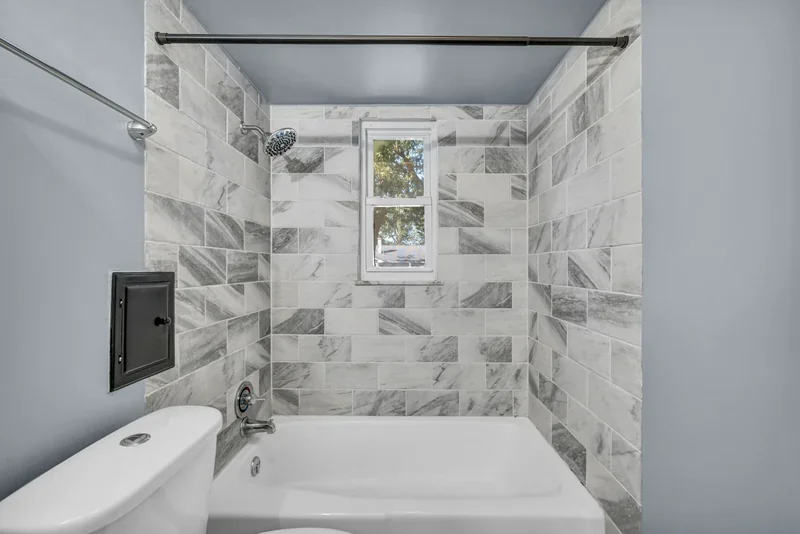
One-day bath liner or full tile remodel: which is right for your home?
You’ve seen the ads for one-day acrylic baths. They’re a fair choice in some homes and the wrong one in others. Here’s the straight comparison.
| One-day acrylic liner or surround | Full remodel with tile or solid-surface walls | |
|---|---|---|
| Time without a shower | Usually 1-2 days | Usually 2-4 weeks for a full gut |
| What happens behind the wall | Often goes over what’s there | Walls and floor opened, inspected and repaired |
| Old pipes and rot | Stay hidden | Found and fixed while the room is open |
| Design choices | Set panel colors and patterns | Any tile, layout, niche, bench or glass |
| Curbless or zero-threshold | Limited | Yes, if the framing allows |
| Best fit | Sound walls, dry subfloor, tight timeline | Older homes, leaks, layout changes, long-term stays |
Quick answer: our take
If your walls are dry, your floor is solid and your pipes are copper or PEX, a quick surround can be a sensible choice. If you have a ceiling stain, soft floor, galvanized pipes or a 1950s mortar-bed bathroom, covering it up just delays a bigger repair. We’ll tell you which one you have during the in-home visit.
Before you sign anything at the kitchen table
- A “today only” deal that disappears if you don’t sign tonight
- A contract with no detailed work plan, no start date and no completion date
- Pressure to put down a large deposit before materials are ordered
Indiana law gives you protections on home improvement contracts. We cover them in the permit section below.
Safer bathrooms
Is a walk-in shower worth it for older Fort Wayne homeowners?
For most people over 60 who plan to stay in their home, yes. The bathtub is the most dangerous spot in the house. A CDC study found that in 2008, roughly 234,094 people aged 15 and older were treated in U.S. emergency rooms for bathroom injuries, and 81.1% of those injuries were falls. Injury rates were highest in and around the tub or shower, and they climbed steeply with age: from 49.7 per 100,000 people aged 15-24 to 200.2 per 100,000 at 85 and older (CDC MMWR).
That matters here. About 17% of Allen County residents are 65 or older, and many live in the same 1950s-1970s ranch they’ve owned for decades, with one bathroom and a tub they now climb into carefully.
What we build into an accessible bathroom
- Low-threshold or curbless shower entry, sloped to a linear or center drain
- A built-in or fold-down bench and a handheld shower on a slide bar
- Shower controls placed near the entry so you can turn the water on without getting sprayed
- Pressure-balanced or thermostatic valves to prevent scalding
- Wood blocking inside the walls so grab bars hold, including bars that double as towel bars
- Slip-resistant floor tile, a comfort-height toilet and brighter lighting
- Wider doorways where the framing allows
Programs that can help with safety upgrades
Indiana CHOICE and Medicaid waiver
Can fund home modifications like grab bars and bathroom changes for eligible older adults. Ask Aging & In-Home Services of Northeast Indiana, the area agency on aging for Fort Wayne.
Veterans
VA home adaptation grants can help eligible veterans. Allen County has 17,926 veterans.
Medicare
Original Medicare generally doesn’t pay for shower conversions or grab bars. Some Medicare Advantage plans offer limited home safety benefits, so check your plan.
Helping a parent?
We’re glad to walk through options with adult children by phone before or after the visit.
Leaks and burst pipes
Water coming through the ceiling or a pipe burst? What to do first
Fort Wayne winters are hard on bathrooms. January lows average about 15°F, the record low is -24°F, and supply lines in outside walls freeze and split during arctic snaps. Slow leaks from a failed shower pan or toilet seal do just as much damage over time.
Stop the water
Close the fixture’s shut-off valve. If you can’t find one or it won’t hold, shut off the main.
Make it safe
Turn off the breaker for any wet light, fan or outlet. Keep people out from under a sagging ceiling.
Take photos
Photograph the water, the stain and the source before cleanup. Your insurance company will ask for them.
Call us
Call (260) 272-8252. We find the source, measure moisture, open what’s wet, dry it out and rebuild.
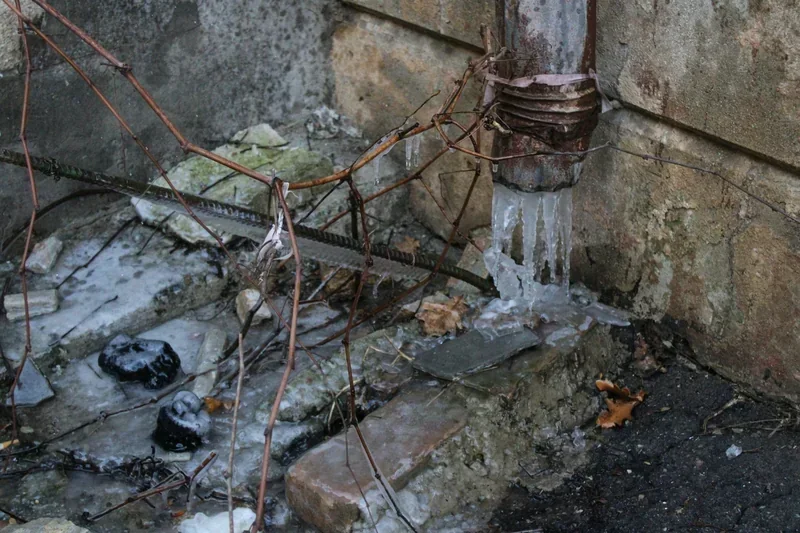
What we repair after bathroom water damage
- Leaking shower pans and water behind tile on soaked greenboard
- Rotted subfloor and joists under toilets and tubs
- Burst supply lines in exterior walls, rerouted to warm interior walls
- Ceilings and walls below an upstairs bathroom
- Mold on drywall and framing caused by the leak, removed before rebuilding
- Basement bathrooms hit by a sewer backup, with a backwater valve to stop the next one
Working with your insurance
Homeowners insurance often covers sudden water damage, like a burst pipe. It usually doesn’t cover a slow leak that’s gone on for months. Either way, we document the damage with dated photos and moisture readings and give you a written repair plan to share with your adjuster.
Many people use the rebuild to fix the bathroom they never liked. If the old tub is coming out anyway, it can be the moment to put in a walk-in shower.
Built for Fort Wayne
How do Fort Wayne’s weather, water and rivers affect your bathroom?
A bathroom built for Phoenix fails in Fort Wayne. These are the local conditions we design around.
Long, cold winters
About 33.6 inches of snow a year and January lows near 15°F, per the National Weather Service. We keep new supply lines out of outside walls or insulate them on the cold side, and we duct fans through the roof or wall so they don’t drip into the attic all winter.
City water vs. well water
City water comes from the St. Joseph River through the Three Rivers Filtration Plant and is lime-softened. Average hardness in 2025 was 130 mg/L, which City Utilities calls moderately soft (2026 Water Quality Report). Homes on private wells outside city service see much harder water, so we suggest coated glass and easy-clean finishes there.
Three rivers and sewer backups
Fort Wayne sits where the St. Marys and St. Joseph rivers form the Maumee. The March 1982 flood damaged about 1,500 homes. About a third of the city’s sewers are combined, and the Tunnel Works project was built to cut overflows and basement backups. Basement bathrooms get backwater valves, sealed ejector pits and flood-tolerant finishes.
Lead in older plumbing
City mains are lead-free, but private lead service lines and old interior piping remain in some older homes. Check your address at Serviceline.cityoffortwayne.org or call City Utilities at 260-427-1234. A remodel is the easiest time to replace old supply lines inside the walls.
Radon
Allen County is in EPA Radon Zone 1, the highest-potential zone. Before we cut a slab for a basement bathroom, we recommend a radon test and keep any mitigation pipe and sump lid sealed.
Humid summers, mildew
Summer humidity feeds the black mildew people scrub every week. The EPA recommends keeping indoor humidity below 60%, ideally 30-50%. A properly sized fan, ducted outdoors and run 20 minutes after showers, does more than any cleaner.
Permits and your rights
Do you need a permit to remodel a bathroom in Fort Wayne?
Quick answer: when is a permit required?
When the work touches plumbing, electrical, ventilation or structure. Moving a drain, adding a circuit, moving a wall or adding a bathroom needs a permit. Cosmetic work like paint or swapping a vanity in the same spot generally doesn’t.
Who issues the permit
The Allen County Building Department issues building permits for both the City of Fort Wayne and unincorporated Allen County. It’s at Citizens Square, 200 E. Berry St., Suite 180 (260-449-7131). The City of Fort Wayne itself doesn’t issue building permits, which surprises a lot of people who call 311.
- Contractors must be licensed and registered with the county before they can pull a permit.
- Plumbing is licensed by the State of Indiana through the Indiana Plumbing Commission. Any job that moves drains or supply lines needs a licensed plumber.
- Homes in Fort Wayne’s local historic districts have had a separate historic review process in place since November 7, 2025. Interior work is usually unaffected, but a new bathroom window or a roof vent facing the street may need review.
- Towns and counties outside Allen County’s jurisdiction have their own building offices. We check the rules for your address.
What Indiana law says about your contract
Indiana’s Home Improvement Contract Act (IC 24-5-11) protects homeowners on residential remodeling jobs. In plain terms:
- The contract should be in writing, with both parties’ names and addresses, the property address, a description of the work and approximate start and completion dates.
- Changes to the contract aren’t enforceable against you unless they’re in writing and signed by you.
- Violations are treated as deceptive acts that the Indiana Attorney General or the homeowner can act on.
Every job we take comes with a written contract, a written work plan and written change orders. If something unexpected turns up behind a wall, you see it, approve it and sign it before we do it.
How it works
What happens when you call Fort Wayne Bathroom Pros?
The same five steps on every job, whether it’s a shower pan or a full primary bath.
You call (260) 272-8252
Tell us what’s going on: the bathroom you want, the leak you found, or the parent who can’t use the tub anymore. We set a time to come out.
Why it matters: we come prepared with the right questions for your house and project.
In-home consultation
We measure, check moisture, look at the pipes, fan and floor, and talk through layout, materials and finishes. No pressure, no same-night signing.
Why it matters: a plan based on your actual bathroom, not a guess from a photo.
Detailed project plan
You get the whole plan in writing: demolition, plumbing, electrical, waterproofing, tile, fixtures, permit and cleanup, plus how hidden repairs in older homes are handled. Nothing is left to memory or a handshake.
Why it matters: you know exactly what’s included, and what isn’t.
Permits, ordering and the work
We pull the permit, order the vanity, glass and tile before demo day, then protect your floors and seal the work area with plastic. Inspections happen before the walls close.
Why it matters: fewer days without a bathroom, and work that passes inspection.
Walkthrough and punch list
We walk the finished bathroom with you, test every fixture and the fan, and fix anything on the punch list before we call it done.
Why it matters: the job ends when you’re satisfied, not when we’re tired of it.
Want the full week-by-week picture? Read our bathroom remodeling process.
Hire with confidence
How do you hire a bathroom contractor in Fort Wayne without getting burned?
Local Facebook groups and Nextdoor threads are full of the same advice. We agree with it, and we’d rather you check us than take our word for it.
Do this
- Talk to two or three contractors and compare their written work plans.
- Confirm the contractor’s license with the Allen County Building Department licensing line, 260-449-7342.
- Search the contractor’s name on mycase.in.gov, Indiana’s court records site.
- Ask for a certificate of insurance.
- Make sure the permit is in the contractor’s name, not yours.
- Pay as the work progresses, not half up front.
- Get every change in writing and signed.
Walk away from
- “We don’t need a permit for that” on plumbing or electrical work
- A large cash deposit before any materials are ordered
- No written contract, or one with no dates and no detailed work plan
- Someone who can start tomorrow on a full remodel. Good crews are usually booked a few weeks out.
- Pressure to sign tonight
- Someone who plans your whole job over the phone without seeing the bathroom
Who we work for
Who do we remodel bathrooms for?
Homeowners across Fort Wayne, and the people helping them decide.
Homeowners staying put
You love your house, not the tub. We build safer, easier bathrooms in the 1950s-1970s ranches and two-stories all over town.
Adult children helping a parent
After a fall or a hospital stay, you need options, a timeline and someone trustworthy in Mom’s house. We’ll explain it all on the phone.
Families upgrading the primary bath
In Aboite, Huntertown and the northeast, the 1990s garden tub nobody uses becomes a large walk-in shower with a double vanity.
Old-house owners
In West Central, North Anthony, Lakeside and Forest Park, we keep the character, work lead-safe and fix what a century of plumbing left behind.
Homeowners dealing with damage
A leak, a burst pipe, a soft floor. You need a straight answer on repair versus remodel, and a crew that can do either.
Landlords, sellers and small businesses
Durable, quick bathroom updates for rental turnovers and listing prep, and restroom updates for small commercial spaces.

FAQ
Bathroom remodeling questions Fort Wayne homeowners ask us
How long does a bathroom remodel take?
A tub or surround swap can take 1-2 days. A full gut remodel of a hall bath usually takes 2-4 weeks of work, plus time to order special items like vanities and glass. We order those before demo day so the room isn’t sitting torn apart while you wait.
Do I need a permit to remodel a bathroom in Fort Wayne?
You need a permit when the work involves plumbing, electrical, ventilation or structure, like moving a drain, adding a circuit or moving a wall. The Allen County Building Department issues permits for Fort Wayne and unincorporated Allen County. Paint and replacing a vanity in the same spot generally don’t need one.
What’s the difference between bathroom renovation and bathroom remodeling?
A renovation restores what’s there: new surfaces, fixtures and finishes in the same layout. A remodel changes the room: moving fixtures, converting a tub to a shower, reworking plumbing or the layout. Many projects are a mix, and we handle whichever one you need.
Is a tub-to-shower conversion worth it?
For most people who rarely take baths, yes. A walk-in shower is easier and safer to use as you age, and the tub and shower area is where bathroom falls happen most. If it’s your home’s only tub and you have young kids or plan to sell to a young family soon, keep a tub somewhere in the house.
Is a one-day bath liner as good as a tile shower?
It’s faster, usually 1-2 days instead of weeks. But a liner goes over what’s there, so leaks, rot and old pipes stay hidden. It makes sense when the walls are dry and the plumbing is sound. In an older Fort Wayne house with a stain or soft floor, a full remodel is usually the better choice.
Do I need to replace old pipes when I remodel?
If your home has galvanized steel, polybutylene or old cast iron in the bathroom, a remodel is the best time to replace it, because the walls are already open. Galvanized pipe corrodes inside and chokes water pressure, which is why so many older Fort Wayne showers just dribble.
Is Fort Wayne water hard?
City water is not very hard. City Utilities lime-softens it at the Three Rivers Filtration Plant, and 2025 hardness averaged 130 mg/L, which the city calls moderately soft. Private wells outside the city system are much harder, and that’s where you see heavy scale on glass and fixtures.
How do I stop mold and condensation in my bathroom in winter?
Run a properly sized exhaust fan that vents outdoors, not into the attic, for about 20 minutes after every shower. A humidity-sensing fan does it for you. If the fan dumps into the attic, moisture freezes there in winter and drips back through the ceiling, so it should be rerouted.
Can you add a bathroom in a Fort Wayne basement?
Usually, yes. If the basement floor sits below the sewer line, the toilet and shower drain to an ejector pump. Because Allen County is in EPA Radon Zone 1 and part of the city’s sewer system is combined, we recommend a radon test before cutting the slab and a backwater valve to protect the new bathroom from sewer backups.
Do you remodel bathrooms in older and historic Fort Wayne homes?
Yes. Homes built before 1978 get lead-safe work practices, and we test suspect old floor tile or mastic for asbestos before demolition. Interior bathroom work in a local historic district is usually unaffected by historic review, but a new window or vent facing the street may need it.
Can you finish a bathroom another contractor left unfinished?
Yes. We look at what was done, check whether a permit was pulled, test anything already closed in where we can, and give you a written plan to finish it. If work was done wrong, we’ll show you before we cover it up.
Do you handle water damage and insurance claims?
Yes. We repair and rebuild bathrooms after leaks, burst pipes and sewer backups. We document the damage with dated photos and moisture readings and give you a written repair plan to share with your adjuster. Your insurance company decides coverage; we make sure the documentation is complete and accurate.
How do I check if a bathroom contractor is licensed in Allen County?
Call the Allen County Building Department licensing line at 260-449-7342 and ask whether the contractor is licensed and registered. For plumbing, check the state license through the Indiana Professional Licensing Agency. You can also search the company’s name on mycase.in.gov for lawsuits.
What should a home improvement contract include in Indiana?
Under Indiana’s Home Improvement Contract Act, the contract should be in writing with both parties’ names and addresses, the property address, a description of the work and approximate start and completion dates. Changes aren’t binding on you unless they’re in writing and signed by you.
Talk to a local remodeler
Ready for a bathroom remodel in Fort Wayne? Call us
Whether it’s a tired 1950s bathroom, a tub that’s become hard to use, a leak that’s stained the ceiling, or a primary bath that never felt right, the first step is the same. Call us, we’ll come look, and you’ll get a detailed project plan for your bathroom.
- In-home consultation
- Detailed project plan before any work starts
- Permits pulled and inspections passed
- No pressure and no half-down deposits
Fort Wayne Bathroom Pros
Phone: (260) 272-8252
Address: 9426 Camberwell Dr, Fort Wayne, IN 46804
Services: bathroom remodeling, bathroom renovation, tub-to-shower conversions, walk-in and zero-threshold showers, tub replacement, vanities, flooring, countertops, accessible bathrooms, water-damaged bathroom repair
Service area: Fort Wayne and nearby Allen County communities